
Veröffentlichung
Johannes Rebmann: A Servant of God in Africa before the Rise of Western Colonialism
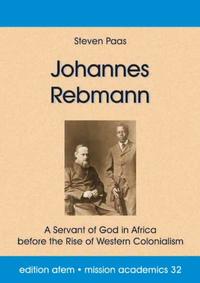
Edition AfeM / Mission academics, 32
Nürnberg VTR, 2011
Steven Paas
Inhaltsverzeichnis
Preface
Motivation
Acknowledgments
1. Introduction
2. Spiritual roots
3. From Gerlingen to Islington (1820-1846)
4. With Johann Ludwig Krapf (1846-1855)
5. From Cairo to Zanzibar (1851-1859)
6. Fruits and loss
7. Lonely and enduring (1866-1875)
8. The last passages (1875-1876)
9. Language Worker
10. The context of Muslim Slavery
11. Missionary
12. Herald
Bibliography
Appendix I: Salimini’s Chichewa
Appendix II: A history of Chichewa lexicography
Inhaltstext
Johannes Rebmann was a 19th-century German Christian, deeply influenced by the Movement of Württemberg Pietism. He was trained to be a missionary in Basel, Switzerland, and he joined the English Church Missionary Society (CMS) which sent him to the Muslim-ruled and slavery-ridden Mombasa area of present-day Kenya. There he stayed for 29 years before returning home to Gerlingen near Stuttgart, blind and sick, soon to die. As a witness of Christ and an expert in languages he paved the way for Christianity to deploy in East and Central Africa. One of his outstanding lexicographical achievements is the first ever Dictionary of the main language of Nyasaland, now Malawi, a country situated at a distance of more than 2000 km of which he scarcely knew the location. He compiled his collection of vocabulary of Chichewa with the help of a slave, Salimini, who like many others was cruelly captured West of Lake Malawi, and through the Swahili-Arab slave market of Zanzibar was sold to a slave-owner in Mombasa. Much in Rebmann’s biography is a paradigm of experiences of today’s transcultural workers in Africa.
Ähnliche Veröffentlichtungen
Martin Heißwolf